
Everything you never knew you wanted to know about....
.. powering your house from the sun.
If you signed up to this substack expecting gorgeous pictures of plants every time then you might want to skip this one. But I did say it would cover ‘Everything under the sun’. By way of consolation, there is chocolate….
Twelve years ago (2011) I put solarPV panels on the south facing roof of my house. In June 2022 I added more to the east/west facing garage and in November ‘22 I installed batteries too. It’s 8am on a chilly April morning, the sun is only just up and it’s -1C outside. My solar panels are already producing enough electricity to run the house. Fridge/freezer, wifi, this laptop etc…
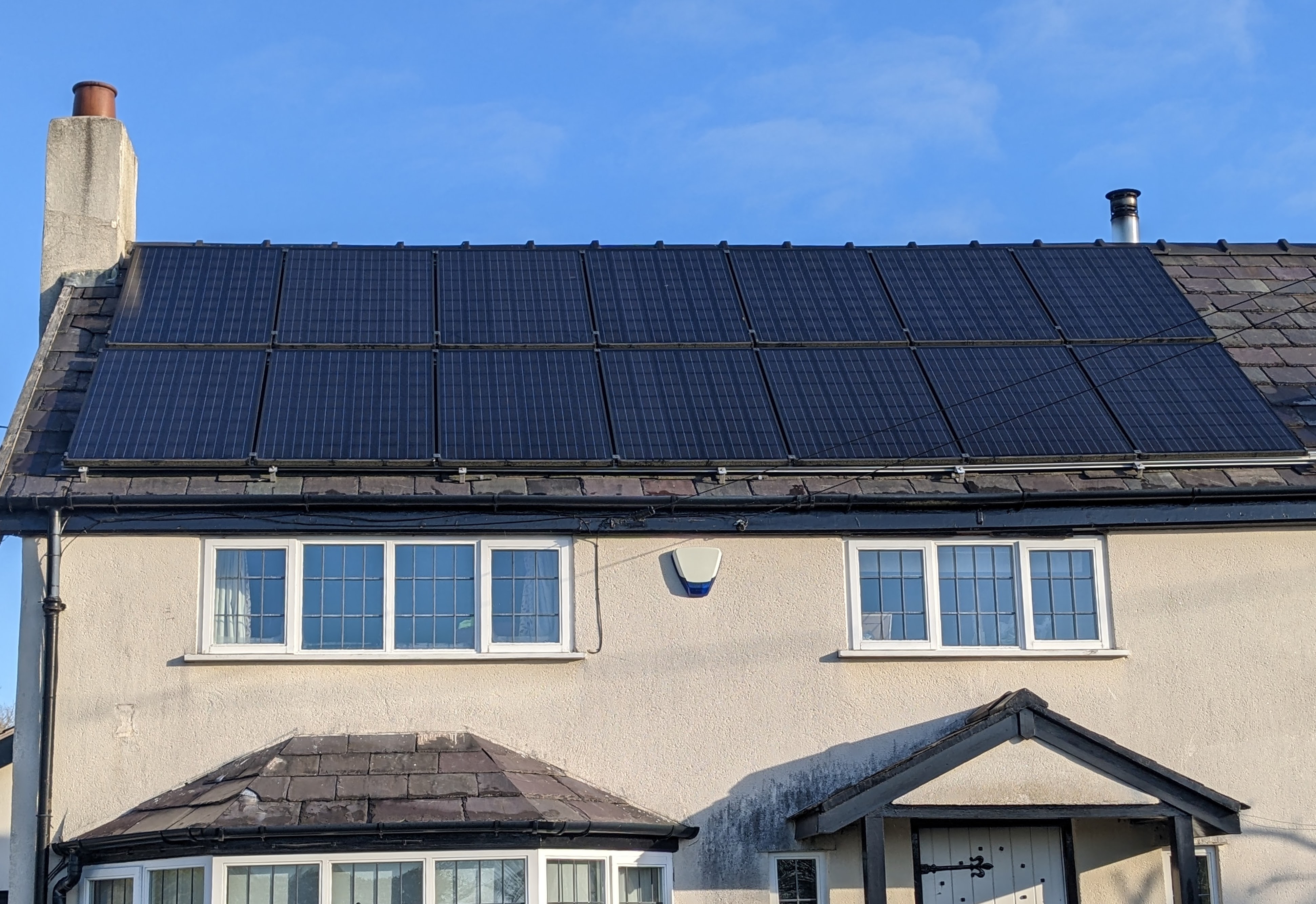
The forecast for today (4th April) is wall-to-wall sunshine so my electricity bill today will be close to zero, no matter what I switch on. Even though it’s cold. SolarPV panels generate electricity directly from light, not from heat.
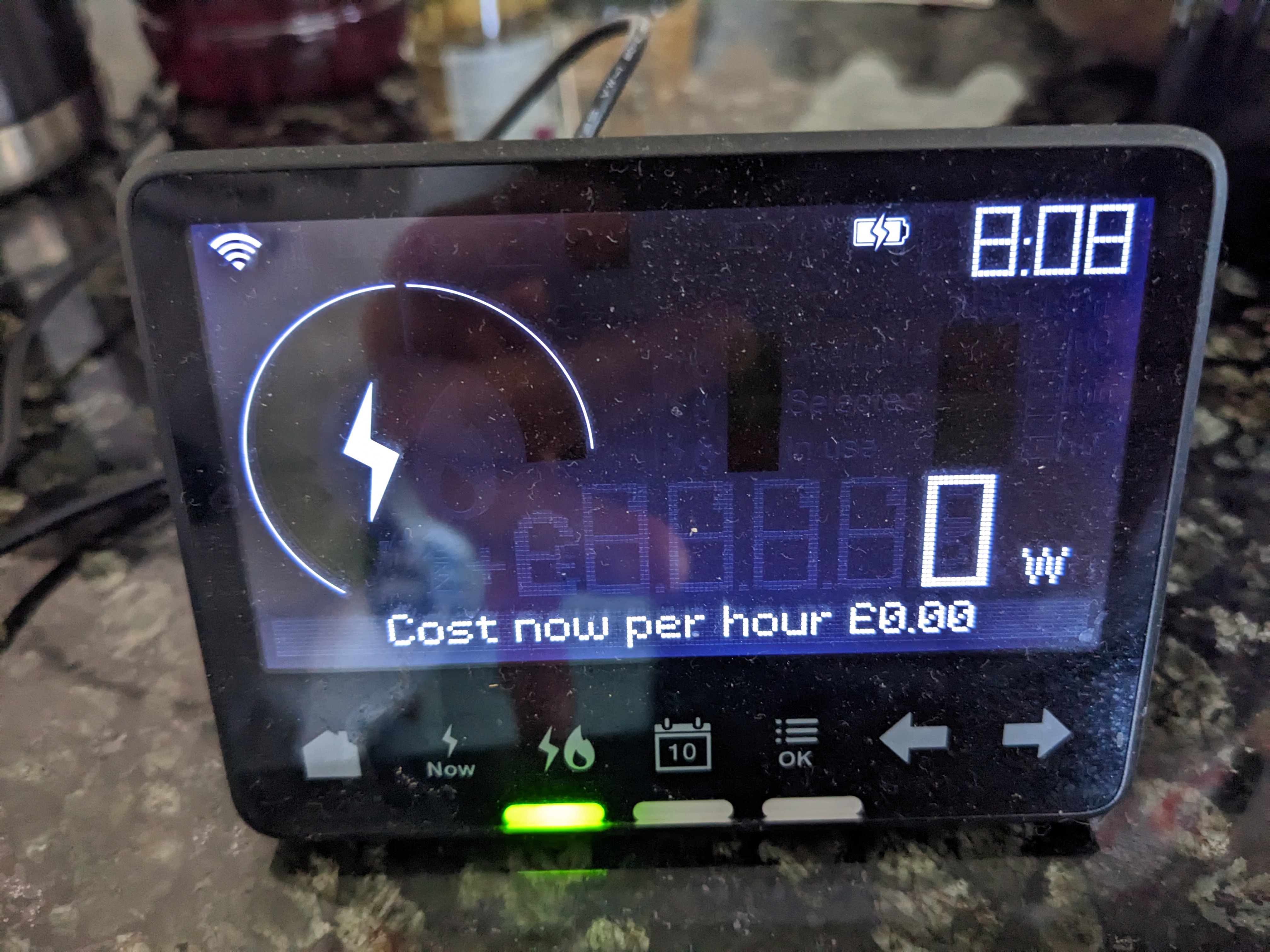
It pains me now to stand in a friend’s kitchen and catch a glimpse of their smart meter display clocking up they cash they will have to pay their electricity provider as they make me a brew. Especially if they have a south-ish facing roof and if I know they could afford the capital outlay (we’ll come back to that…). Worse, if their electricity provider isn’t UK owned, then the profits on my friend’s payments will quite likely end up in the pockets of someone sipping Martinis on a yacht in the Caymans. And that is even more infuriating.
This post is about what I’ve learned from 12 years of having SolarPV on my house and the six months since I added batteries. I am not aiming to be ‘off-grid’ - that way lies obsession and frustration. The UK grid delivers electricity instantaneously and at a ‘speed’ that no typical domestic battery set-up can deliver. My aim is to live a totally normal modern life, drawing from the grid at the cheapest available rates when I need to. My electricity bill is down by 75% in winter and probably 90% this summer.
To make the most of any solar set up it helps to understand a bit about how it all links together and look at some numbers. I know some people get spooked by figures, and nebulous-sounding words like kilowatthours. If that’s you, the solution is chocolate (isn’t it always!). Specifically, giant Galaxy bars. Stay with me, or skip down to the nice graphs if comparing electricity and chocolate makes you queasy….

The Galaxy-powered house: Think of all the electrical gadgets in your house as feeding on large bars of Galaxy which arrive continuously on a conveyor belt. My house munches around 12 bars a day in total, on an average day. At night, the conveyor belt moves very slowly - my house may only get through one bar all night. When I wake up and switch the kettle on, the belt has to speed up and deliver at least 2 bars an hour. Thankfully it’s only on for a few minutes so it only gets through a couple of chunks before the water boils and the supply can slow down again. Phew.
You might imagine my house as having three ‘conveyor belts’: one from the grid, one from my solar panels and one from the batteries (I know it’s not like that electrically, but logically it is). The house uses whatever the solar panels are producing first, then draws from the batteries and then draws any extra it needs from the grid.
If your brain melts when you see ‘kWhr’ or ‘unit’, just mentally replace it with an image of one Galaxy bar sliding into the house every hour and you’ll be just fine.
Electricity produced by my solar panels in 2022/2023
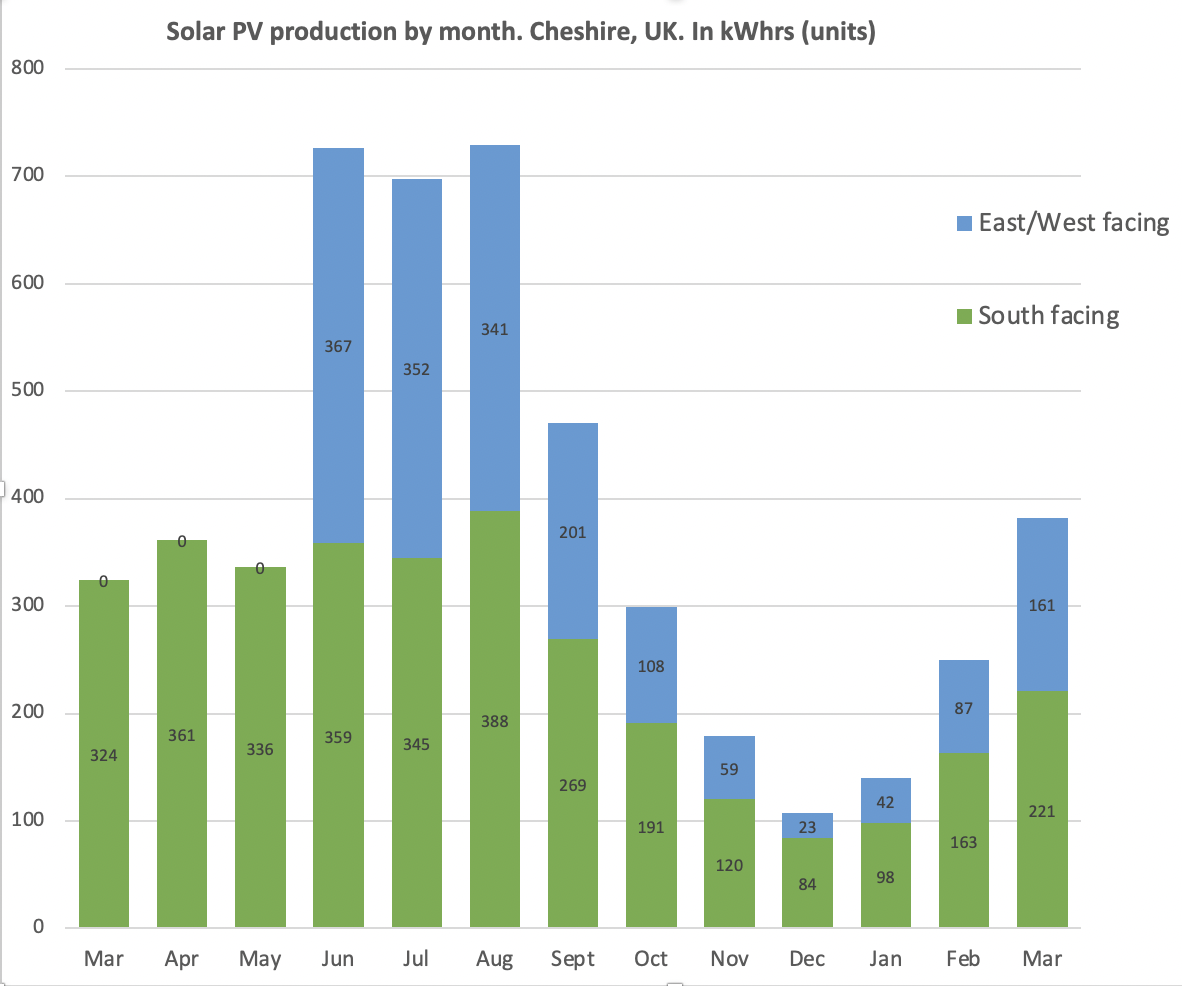
I do love a good graph. This one shows the amount of electricity my solar panels have produced in the past year. The figures are in kWhrs, or units, or Galaxy bars, whichever you prefer to think about.
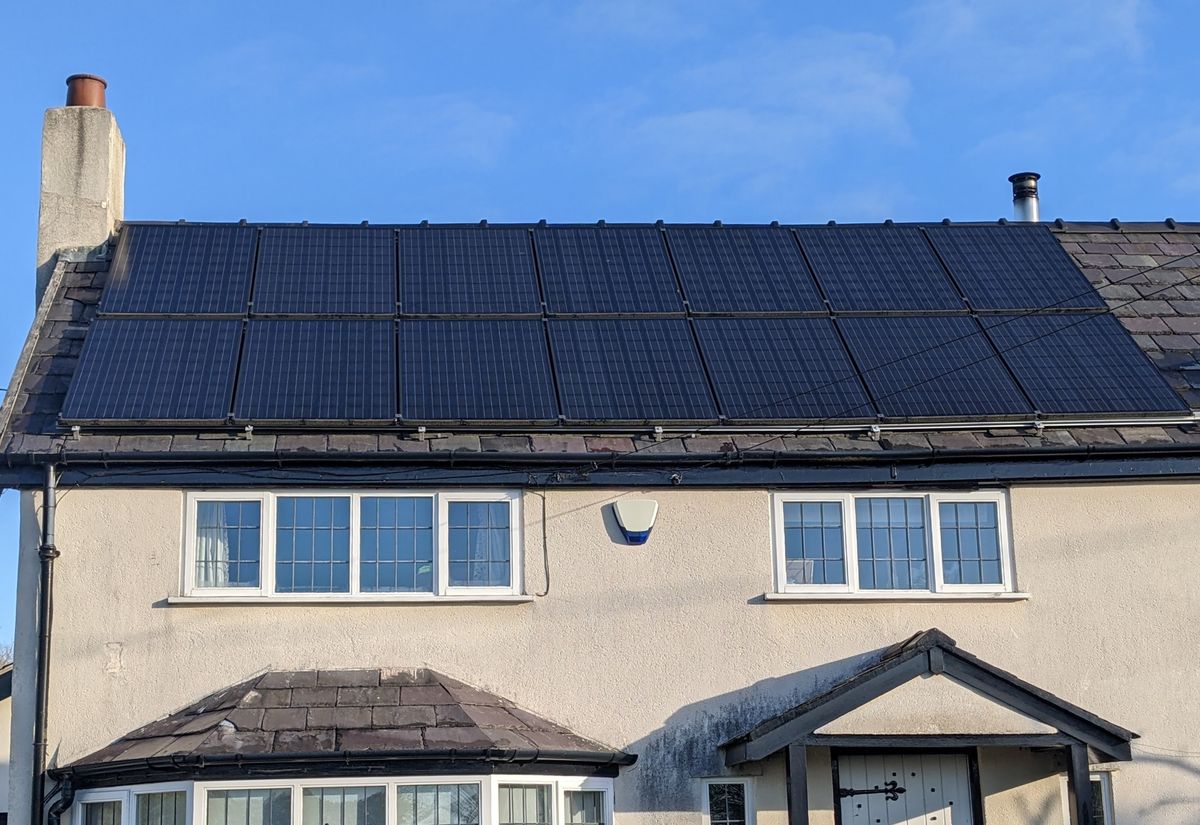
My 12 year old south facing panels, pictured at the top and shown in green on this graph have a maximum output of 3.15kWhrs (i.e. the maximum amount of electricity they can deliver is 3.15 units per hour in direct sun). They produce a total of around 3,000 units a year, or £1,000 worth of electricity at 2023 prices.
The East/West facing ones were installed in June 2022 and have a maximum output of 3.2kWhrs, but this never happens in practice, because they are split 50/50 each side of the garage roof. It’s impossible for the sun to shine directly on both sides at the same time. But the east facing ones start generating early in the day and the west facing ones keep going till sunset. And they are new, highly efficient panels which work well from indirect light reflected from the sky. As you can see above, in June and July last year they actually produced more than my south facing ones, which surprised me. In winter they are partly shaded by the house, so produce a lot less.
Using versus exporting electricity
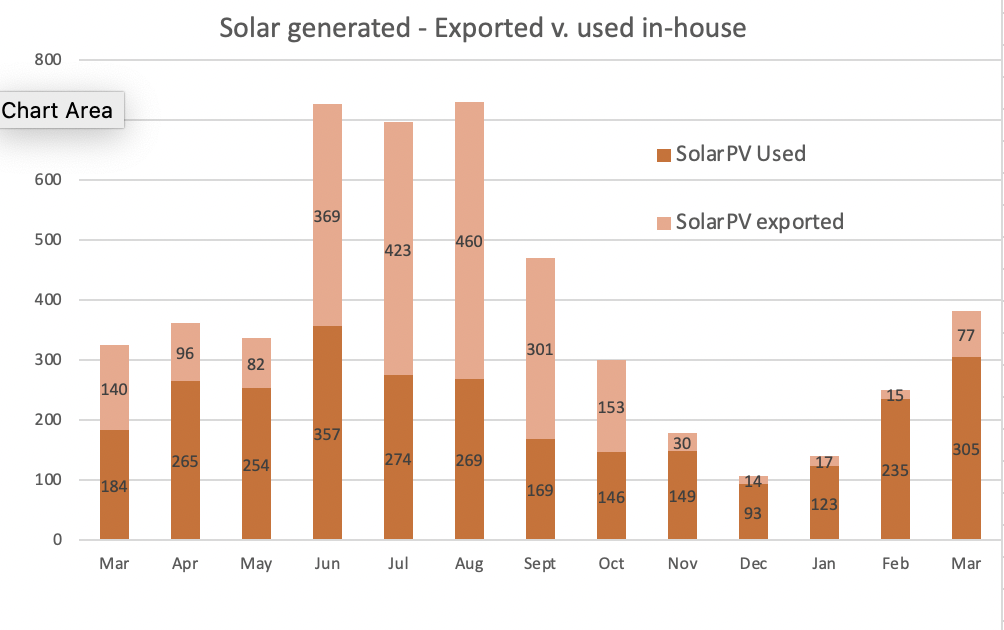
Without batteries, you need to use the electricity your panels generate straight away by plugging things in. If you don’t use it immediately, it will be exported to the grid. Your meter won’t run backwards (old analogue ones did!); modern smart meters have a separate display for exported electricity. You can get paid for it, but it’s not much. Far, far better to use what you can as you go along, but this is clearly difficult if are you out of the house during the day. It’s truly maddening to come home just as the sun is going down and have to buy electricity when everything your panels have generated all day has vanished into the grid for next to nothing.
You can see from above that last summer I exported around half of my total generation after I added the new garage panels in June. In effect, all I’d achieved was generating more and exporting it all to the grid each day. But once I added the batteries in November (13kWhr capacity - roughly enough to last a day) I was able to store and use a much higher proportion of my own electricity.
Where my electricity comes from now:
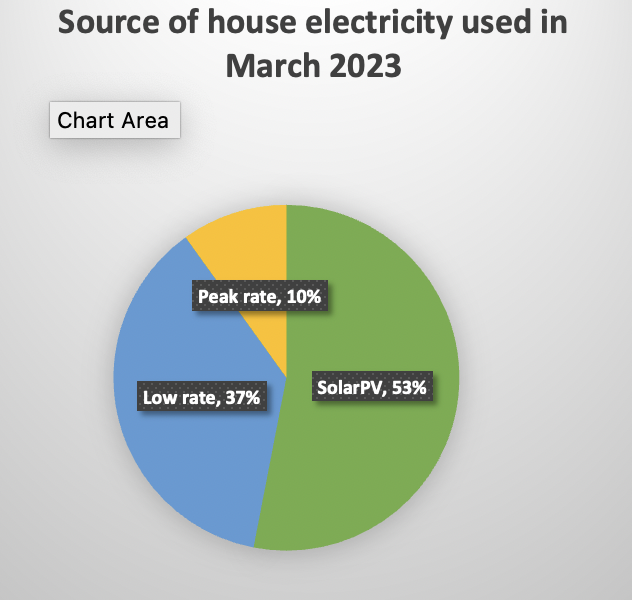
Batteries can obviously be used to store your surplus solarPV generation during the day so that you can use it in the evening, but the game-changer for making batteries financially viable is the availability off off-peak tariffs like Octopus ‘Go’. Today, a unit of electricity is 34p (capped by the government, for now). But between 0030 and 0430 every night I can buy electricity for 12p/unit, store it in the batteries (and charge my car…) and use it the next day. Outside of this cheap rate period my buy price is 44p/unit so you do need to think through whether it’s the right tariff for your usage and your battery storage. It works for me as my battery storage is roughly a day’s worth of electricity.
Making the most of your panels and battery storage
You can just put panels on your house, install batteries and leave it all to work, which it will, perfectly seamlessly, and it will save you money on your bills.
But to really make big savings you need to think ahead and adapt when you switch things on. I think I’m now saving around £1,500 a year, or 80% off my electricity bill. Here’s what I do…
- Look ahead at tomorrow’s weather forecast. I try and estimate how much my panels are likely to produce and then decide how much (if any) cheap rate electricity to buy overnight and store in the batteries. Better to err on the side of buying too much cheap rate electricity than have to buy at peak rate later on. It’s a two minute job and saves me hundreds of pounds a year.
- Do one thing at a time. Once the sun has gone down, my batteries can deliver a maximum of 3kW per hour (you can buy inverters that will deliver 5kW, but 3kW is standard). So if I put the washing machine on and then start the dishwasher, and then put the kettle on, it’s likely I’ll be drawing a total of around 6kW. Even if the batteries are full, they can’t deliver enough power (the battery-to-house conveyor belt can’t move fast enough!). So you’ll end up buying the difference from the grid. If you make a brew first, then run your appliances one after another, you can run them all from your batteries.
- If you can, plan ahead to do high energy tasks when the forecast is sunny. Anything involving heat uses a lot of electricity. Washing machines, baking, ironing, kiln-work… Wait till the sun comes out and then get cracking. A sunny Saturday is a busy day here!
- For really high energy usage equipment, like a kiln, or charging an electric car, the very best time to use them is when the batteries are full and it’s sunny. Now you can pull 3kW from the battery and 3kW from the solar panels simultaneously (in effect, they act as if they are on separate conveyor belts running side by side)
- If you’ve got a hot water tank (not a combi boiler) you can connect your solar panels to the immersion heater. Instead of exporting surplus electricity you can use it to heat your water.
- Keep an eye on your solar battery app. If you see the batteries getting close to full, have a think - is there anything you can do to use it, rather than export it? Any equipment batteries to charge? Any damp washing to dry? My daughter has a de-humidifier on an app controlled switch. When her solar batteries are full, she remotely switches on the de-humidifier, which gently heats the house while she’s at work.
Money
The big question - how much does it all cost and is it worth it?
Today, a typical 4kW solar panel installation (10 x 400W panels) with a 7kW battery will cost you around £10,000. There are no grants and no subsidies available at the moment, unless you can apply for a ECO grant, which is aimed at people in, or close to fuel poverty. Contact your electricity supplier for info. But take it slow - there are grant-chasers around who will take the cash and do a very poor job. Trust me, I’ve seen it…
If your electricity usage is around 4,000kWhrs a year or higher (most houses use more than this) and you are willing to shift your electricity usage somewhat around sunny weather, then you should be able to save around £1,500 a year at today’s prices, giving you a payback period of 6-7 years. After that, you have free electricity for as long as the system lasts (at least 10 years. More like 20-25). If electricity prices continue to go up, as they have always done in the past, you’ll pay yourself back even quicker.
If you don’t have the money…
..then you’re one of millions of people itching to do this but without the cash to do it. I can’t help you, except to say that there really should be ultra-cheap loans for all households who want to put solar on their house. The savings you will make on your electricity bill will more than cover the payments. If you are up to date with mortgage payments you should also have the automatic right to add the capital to your mortgage at a suitably low rate.
Sadly, I am not in government and can’t fix this for you, but that’s what I would do.
Good luck and do feel free to ask questions - I’ll answer them if I can. Bear in mind I have no technical background on this, I’m just an interested amateur with a liking for graphs (hello Hazel and Clare, my fellow graph-lovers) and my knowledge is limited to my own experience.
PS - I also have a solar hot water system, but that’s a topic for another day.